Getting Quotes from Builders in Dublin: What to Expect and What to Ask

Getting quotes from builders in Dublin is one of the most critical steps in any construction or renovation project. A detailed, transparent quote protects both you and the builder, setting clear expectations about scope, cost, timeline, and payment terms. With over 35 years of building experience in Ballinteer and Dublin 16, BR Building Services has helped hundreds of homeowners navigate this process. This guide explains what to expect, what to ask, and how to compare quotes fairly so you choose the right builder for your project.
Whether you're planning an extension, renovation, or new build, understanding how to evaluate a builder's quote separates informed decisions from costly mistakes.
How Many Quotes Should You Get?
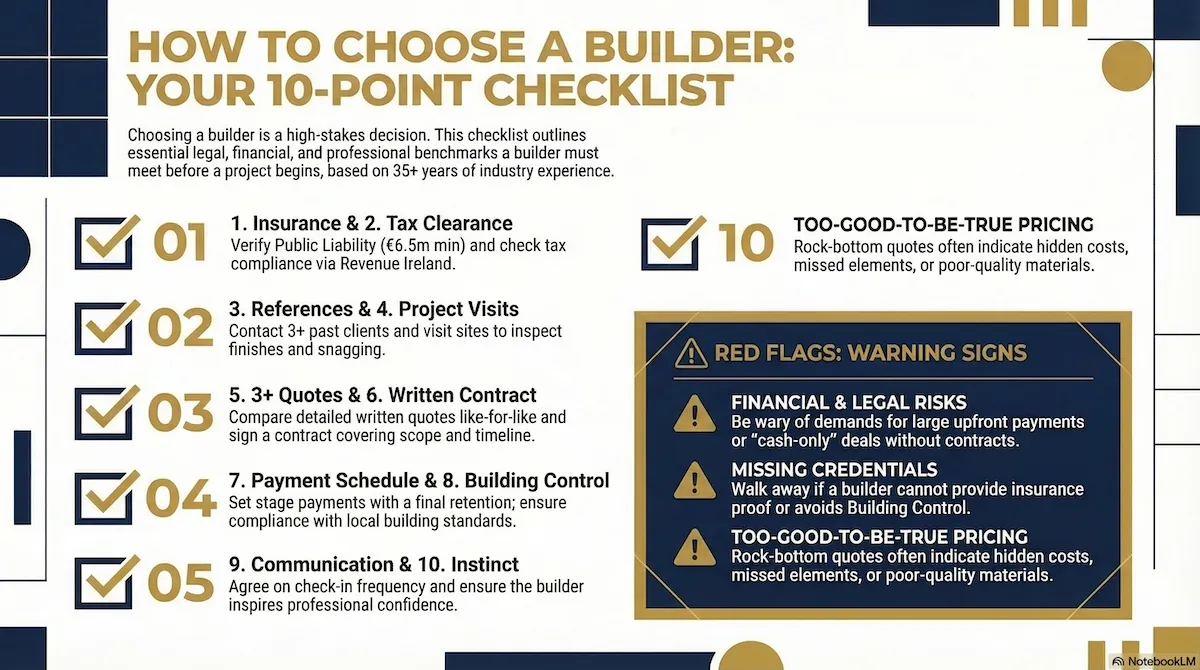
The simple answer: at least three. Getting multiple quotes serves several purposes. First, it gives you a realistic price range for your project. Second, it allows you to compare different builders' approaches, timelines, and specifications. Third, it reveals red flags—if one quote is dramatically different from the others, you'll want to understand why.
With fewer than three quotes, you lack context. With more than six, you may experience diminishing returns—analysis paralysis sets in, and comparing too many options becomes overwhelming. Three to five quality quotes is the sweet spot.
Importantly, the cheapest quote is rarely the best choice. A quote significantly lower than others often signals inadequate specification, hidden costs to emerge later, or a builder overcommitting and cutting corners. Conversely, the most expensive quote isn't automatically superior—you're paying for reputation, craftsmanship, and reliability.
What Should a Proper Quote Include?
A professional quote is far more than a single line item stating a total cost. Here's what every comprehensive quote must contain:
Itemised Breakdown
Each cost should be listed separately—materials, labour, plant hire, site clearance, scaffolding, etc. This transparency allows you to understand where your money goes and identify areas for potential savings or upgrades. A vague quote stating "construction works: €50,000" without detail is a major red flag.
Materials Specification
The quote should specify the exact materials being used—not just "windows" but "PVCu double-glazed casement windows, white finish, 1.2m x 1.5m." This prevents the builder later substituting cheaper alternatives. Specification documents should reference brand names, sizes, colours, and quality grades.
Project Timeline
The quote should state the estimated start date, duration, and completion date. It should also clarify what delays might be beyond the builder's control (weather, Building Control delays, supply chain issues) and how these affect timelines.
Payment Schedule
How will you pay? Typical schedules for extensions run: 10-20% deposit on commencement, interim payments at key milestones (foundations in, roof on, first fix complete, second fix complete), with final payment on completion. Never agree to large upfront payments—they're a major risk indicator.
Scope of Work and Exclusions
What's included and what's not? Exclusions matter enormously. For example, is planning permission included in the cost? Building Control fees? Temporary protection? VAT? Are site clearance and disposal included? A proper quote explicitly states what is and isn't covered.
Contingency Allowance
Unforeseen issues—hidden asbestos, structural defects, service relocations—are inevitable. A contingency (typically 5-15% of the contract value, held separately) covers these costs. A quote without contingency provision is unrealistic.
Quote vs. Estimate vs. Tender: What's the Difference?
These terms are often used interchangeably, but they have distinct meanings in construction:
| Type | Definition | Binding? | Detail Level |
|---|---|---|---|
| Quote | Fixed price for a specific scope of work. Builder commits to this price. | Yes (if accepted) | Detailed specification, itemised costs, clear scope |
| Estimate | Approximate cost based on limited information. Price may change as details emerge. | No | Basic outline; subject to revision |
| Tender | Formal request for pricing, typically for larger or more complex projects. Builder submits detailed proposal. | Yes (if accepted) | Very detailed; includes methodology, resources, timescales |
For most Dublin residential projects (extensions, renovations, etc.), you'll receive quotes. An estimate indicates the builder hasn't fully scoped your project—push for a detailed quote instead. A tender approach is typical for larger projects or when competitive bidding is desired.
Key Insight
Always request a quote, not an estimate. A quote is a fixed commitment to price and scope. An estimate leaves wiggle room for the builder to increase charges later as "variations" or "unforeseen costs." Once you accept a quote in writing, the builder is contractually bound to deliver at that price (barring variations you both agree to).
Red Flags in Builder Quotes
Certain warning signs should trigger careful scrutiny or rejection of a quote:
Price Far Below Market Rate
If a quote is 20-30% lower than others for identical scope, ask why. The answer might be cutting corners on materials, rushing through work, or underpricing to win the job then submitting variations. Legitimate reasons include bulk material discounts or off-peak availability, but get these explained in writing.
Vague or Generic Specification
Quotes listing "standard finishes," "appropriate materials," or "standard specification" without specifics are problematic. You don't know if you're getting budget-grade or premium finishes. Insist on detail.
Large Upfront Payments (30%+)
Industry standard is 10-20% deposit. Anything significantly higher is risky—if the builder becomes insolvent or abandons the job, you've lost substantial money. Deposits protect the builder's commitment, not fund their business operations.
No Breakdown or Contingency
A single lump-sum quote without itemisation or contingency provision is unprofessional. How will unforeseen costs be handled? This ambiguity leads to disputes.
No Completion Date or Timeline
Vague timelines ("approximately 14 weeks") are concerning. What happens if the project runs over? Is there a penalty? A professional quote specifies start and completion dates, or at least a defined duration with clear conditions affecting timescale.
Exclusion of VAT (then Added Later)
In Ireland, VAT on building work is 13.5%. A quote excluding VAT, with a note that "VAT will be charged," is poor practice. Always request quotes inclusive of VAT so you know the true cost upfront. This prevents unpleasant surprises.
No Insurance or Warranty Details
The quote should confirm the builder carries public liability insurance (minimum €6.5 million) and provide a warranty on workmanship (typically 1-2 years). Absence of these details is a major concern.
Essential Questions to Ask Your Builder
When requesting quotes, ask these questions to gauge professionalism and gather critical information:
Experience and References
"How long have you been operating as a builder, and do you have references from similar Dublin projects?" Ask for contact details of recent clients, ideally those who've completed projects of similar scope. Call them and ask about the builder's reliability, quality, and how well they handled changes and unforeseen costs.
Insurance and Compliance
"Can you provide proof of public liability insurance and employer's liability insurance?" A professional builder carries both. Insurance should be current and adequate. Also ask if they're registered with Revenue as a contractor (important for your own tax purposes if claiming expenses).
Planning and Building Control
"Will you handle planning permission applications and Building Control registration, or is this my responsibility?" Some builders assume these costs; others don't. Clarify this upfront. Building Control approvals are mandatory—don't work with a builder unfamiliar with Dublin's requirements.
Subcontractors
"What subcontractors will you use (electrician, plumber, etc.), and are they included in your quote, or will you source them with approval from me?" Know whether labour is in-house or subcontracted. Both are acceptable, but transparency matters.
Variations and Changes
"How are variations handled? If I change scope or unforeseen costs arise, what's the process?" The answer should include written variation orders, approved by both parties before work proceeds, with clear pricing. Avoid builders who make changes informally then bill you later.
Defects and Warranty
"What warranty do you provide on your workmanship, and what's your process for addressing defects?" Standard is 12 months, during which the builder rectifies defects at no cost. Some offer extended warranties. Define what's covered and how disputes are resolved.
Site Conditions and Safety
"How will you manage site safety, site security, and neighbour relations?" Professional builders have health and safety protocols, site insurance, and plans for managing dust, noise, and parking. This matters in suburban Dublin where neighbouring properties are close.
Payment Terms
"What's your payment schedule, and what triggers each payment?" Ensure the schedule is tied to measurable milestones (foundations in, roof on, etc.), not arbitrary dates. This protects you—you don't pay for incomplete work.
Delays and Extensions
"If the project is delayed beyond the agreed completion date, are there penalties or compensation mechanisms?" Some contracts include liquidated damages (a defined daily cost for delay) protecting you if the builder runs over. Others leave this undefined—avoid the latter.
Comparing Quotes Fairly: It's Not Just About Price
Once you have three quotes, comparing them requires more than looking at the bottom line. Create a comparison matrix including:
- Total price (including VAT)
- Specification detail and material quality
- Timeline and duration
- Payment schedule breakdown
- What's included vs. excluded
- Contingency allowance
- Builder's experience and references
- Insurance and warranty
- Response time and communication quality during quote process
The builder who communicates clearly, provides detailed quotes, answers questions thoughtfully, and has strong references often delivers better value than the cheapest option. Price is one factor; reliability, quality, and professionalism matter equally.
Understanding Provisional Sums and Prime Cost Items
More complex quotes may include provisional sums and prime cost items. These are legitimate tools for managing uncertainty:
Provisional Sum: An allowance for work that can't be precisely quantified upfront. For example, "electrical rewiring—provisional sum €3,500" acknowledges the exact scope will be determined once walls are opened. The builder adds a mark-up (typically 15-20%) to cover management, and you pay the actual cost plus mark-up when work is complete.
Prime Cost Item: An allowance for materials (usually specialist items like custom windows or bespoke joinery) where the exact cost isn't confirmed yet. The quote includes the estimated cost plus a mark-up. The actual amount paid is the true cost of the item plus the agreed mark-up. For example, "bespoke kitchen—prime cost €12,000 + 15% mark-up."
Both protect the builder from unknowns and you from underquoting, but they create variation opportunities. Ensure any provisional sum or prime cost item is clearly itemised with a reasonable allowance and mark-up percentage defined upfront.
What's Typically NOT Included in a Quote?
Understanding exclusions prevents budget surprises. Typical exclusions include:
- Planning permission applications (unless explicitly included)
- Structural engineering design (architects' or engineers' fees)
- Building Control fees (though sometimes builders include this)
- Asbestos surveys or removal (if pre-1980s property)
- Temporary site works beyond basics (specialist scaffolding, shoring, dewatering)
- Items you've specified from elsewhere (if you're supplying materials, this should be stated)
- Making good externally (landscaping, fencing repairs)
- Decoration beyond basic finishes (bespoke painting, wallpaper, etc.)
- Utilities reconnection (gas installation, EICR testing)
Ask your builder explicitly about these items. If they're important to your project, ensure they're either included with a price or listed as exclusions you'll arrange separately.
VAT on Building Work in Ireland
Building work in Ireland is subject to 13.5% VAT. This is a standard charge, not optional. Your quote should explicitly state whether the quoted price includes or excludes VAT. Always ensure quotes are inclusive of VAT—this is the true cost you'll pay.
Some builders quote "VAT to be added," leaving the final cost unclear. This is poor practice. Request a revised quote clearly showing the total amount including VAT.
For tax purposes, you may reclaim VAT if building a dwelling (new construction), but rates are complex and vary. Consult your accountant. Most renovation and extension work is standard rated (13.5%), with limited relief available.
Getting Your Quote in Writing
Never rely on verbal quotes or rough sketches. Every quote must be in writing, signed by the builder, and dated. The written quote should be comprehensive, covering all points outlined above, and include a validity period (typically 28 days—after which prices may change due to material cost fluctuations).
Once you accept a quote in writing (typically by signing a copy and returning it), you have a legally binding agreement. Before signing, ensure everything is clear. If the quote includes terms and conditions, read them carefully. If anything's unclear, ask for clarification in writing.
Pro Tip
Keep all quotes, emails, and written communication about your project. If disputes arise later, written evidence of what was agreed is invaluable. Some homeowners photograph the site before work begins and maintain a project diary—this creates a clear record of timeline and quality.
Why BR Building Services Provides Transparent Quotes
With 35+ years building in Dublin 16 and Ballinteer, we've learned that transparent quotes protect both builder and homeowner. Our quotes include:
- Detailed itemisation of all costs and labour
- Comprehensive materials specification with brand names and quality grades
- Clear timeline with realistic completion date
- Defined payment schedule tied to measurable milestones
- Explicit scope and exclusions
- Contingency allowance for unforeseen costs
- All-inclusive pricing (VAT included)
- Insurance and warranty details
We answer every question thoroughly and provide references from recent Dublin projects. Our clients appreciate the clarity—they know exactly what they're paying for and when it will be completed.
Next Steps: From Quote to Contract
Once you've selected a builder based on quote, experience, and references, the next step is formalising the agreement. A simple letter of acceptance referencing the quote often suffices for smaller projects. Larger projects benefit from a formal contract detailing terms, conditions, payment schedule, insurance, liability, and dispute resolution.
Before signing any agreement, review it carefully. If something's unclear, ask for explanation in writing. Don't feel pressured to sign immediately—take time to understand your obligations.
A well-structured quote followed by a clear agreement sets the foundation for a successful project. Invest time upfront to get these details right, and you'll avoid countless headaches down the line.