How to Improve Your BER Rating: A Step-by-Step Guide for Dublin Homeowners
If you own a home in Dublin, you've probably heard about BER ratings—but what do they really mean, and how can you improve yours? A Building Energy Rating (BER) assessment determines how energy-efficient your home is, affecting not just your heating bills but also your property's resale value. With over 35 years of building experience in Ballinteer and South Dublin, BR Building Services has guided hundreds of homeowners through energy upgrade projects that genuinely improve living comfort and financial returns.
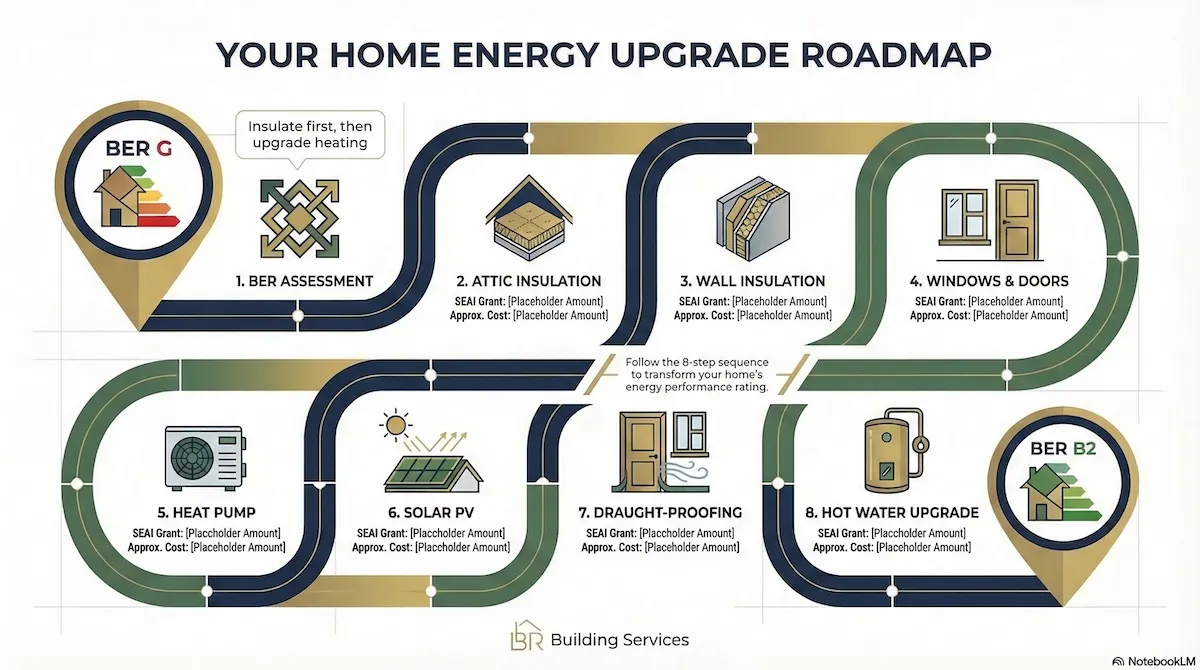
This comprehensive guide walks you through eight proven steps to improve your BER rating, the realistic improvements you can expect, available SEAI grants, and how to prioritise your investments for maximum impact.
Why Your BER Rating Matters
Your BER rating isn't just a number—it's a reflection of your home's energy efficiency, measured from G (least efficient) to A (most efficient). A poor BER rating means higher heating bills, reduced comfort (cold spots, draughts, difficulty maintaining temperature), and significantly lower property values. Recent studies show that each BER grade improvement can increase property value by 5-10%, making energy upgrades one of the best investments Dublin homeowners can make.
The Irish government, through the Sustainable Energy Authority of Ireland (SEAI), actively encourages homeowners to upgrade through substantial grant schemes. Understanding these grants and the logical sequence of improvements is essential to maximising your return.
Step 1: Get a BER Assessment First
You cannot improve what you don't measure. Before spending money on upgrades, commission a professional BER assessment from a qualified assessor (typically €100-€200). This assessment identifies your current rating and provides a detailed breakdown of where you're losing energy.
The BER report will highlight:
- Your current energy rating (A-G)
- Estimated annual heating and cooling costs
- Carbon emissions profile
- Specific recommendations for improvement, prioritised by impact
This information is invaluable because it shows you precisely where energy is being wasted. Some homes lose more heat through the roof; others through walls or poor windows. Your assessment guides your investment decisions.
The Strategic Approach: Insulate First, Then Heat
The single most important principle in energy upgrading is insulate first, then upgrade heating. Many homeowners make the mistake of installing a fancy new boiler before addressing insulation, resulting in wasted money because the heat escapes immediately. The correct sequence is: (1) improve the building envelope (insulation, windows, airtightness), then (2) install efficient heating to match the reduced demand.
Step 2: Attic Insulation—The Biggest Bang for Your Buck
Approximately 25-30% of heat loss occurs through the roof and attic. Attic insulation is the single most cost-effective energy upgrade you can make, with a typical payback period of 3-5 years through reduced heating bills alone.
What to Install
Modern attic insulation typically achieves 300-400mm thickness of mineral wool or cellulose batts, achieving a U-value of 0.10-0.12 W/m²K (much better than older homes with 50-100mm). This dramatically reduces winter heat loss and summer heat gain.
Cost and Grant
A typical Dublin semi-detached home with 60 m² of attic space costs €2,000-€3,500 to fully insulate. The SEAI Home Energy Grant covers up to 50% of costs (typically €1,000-€1,500). Your net cost: €1,000-€2,000 for one of the best investments available.
BER Impact
Upgrading from minimal attic insulation to modern standards typically improves BER by 1-2 grades (e.g., G to E, or E to D).
Step 3: Wall Insulation—Cavity or External?
Walls account for 20-25% of heat loss. The approach depends on your home's construction type.
Cavity Wall Insulation
If your home (built post-1970s) has a cavity wall, injecting polyurethane foam or mineral fibre insulation costs €2,500-€4,500 for a typical semi-detached home. The SEAI grant covers 50-60% (€1,500-€2,500). This is cost-effective, non-invasive, and improves BER by 1-2 grades.
External Wall Insulation (EWI)
For solid-wall homes or where cavity insulation isn't suitable, external wall insulation is more comprehensive but expensive: €12,000-€25,000 for a semi-detached home. SEAI grants of €2,500-€5,000 help, but this requires professional design and installation. The investment is justified for properties targeting A or B ratings, or if you're refurbishing externally anyway.
BER Impact
Cavity wall insulation alone typically improves BER by 1-2 grades. Combined with roof insulation, you may jump from G to D or lower C—a transformational improvement.
Step 4: Upgrade Windows and Doors
Windows and doors account for 10-15% of heat loss. Single-glazed windows from older homes lose heat rapidly; modern double or triple-glazed units with low-emissivity (low-E) coatings perform dramatically better.
Double vs. Triple Glazing
Double-glazed A-rated windows (U-value 1.0-1.2 W/m²K) are standard in Dublin and cost €400-€700 per window installed. Triple-glazing (U-value 0.5-0.7 W/m²K) is premium but increasingly justified for top BER grades: €600-€1,000 per window. For a typical 10-window semi-detached, expect €6,000-€10,000 for all windows and doors.
Grant Support
The SEAI grant covers 50% of window replacement costs (up to €1,500-€2,000 depending on household income). This makes the investment more palatable.
BER Impact
Upgrading all windows and doors typically improves BER by 0.5-1 grade. The real value is improved comfort (no cold draughts, better condensation control) and lower heating bills.
Step 5: Upgrade Your Heating System (Heat Pump is Ideal)
Now that you've improved your building envelope (after insulation upgrades), you can rightsize your heating system. A heat pump is the gold standard for energy efficiency, especially post-insulation.
Air-Source Heat Pump
Modern air-source heat pumps extract heat from outdoor air, even in cold weather, and deliver it efficiently indoors. For a Dublin semi-detached, installation costs €8,000-€12,000. SEAI grants cover 50-80% of costs (€4,000-€8,000 depending on household income), making net cost €2,000-€6,000. These units achieve efficiency ratios (COP) of 3.5-4.5, meaning every unit of electricity produces 3.5-4.5 units of heat.
Ground-Source Heat Pump
If you have suitable space, ground-source heat pumps are even more efficient (COP 4-5) but cost €15,000-€25,000. SEAI grants are similar (€4,000-€8,000), so net cost is €8,000-€18,000. Primarily justified for properties targeting A or B ratings.
Hybrid Systems
Some homeowners use hybrid systems: heat pump for 80% of heating, gas boiler backup for peak winter demand. This is cost-effective and practical: €10,000-€15,000 installed, SEAI grant €4,000-€6,000.
BER Impact
Replacing an old boiler with a heat pump improves BER by 2-3 grades, especially when combined with insulation upgrades. The improvement is most dramatic in properties that have already been well-insulated.
Step 6: Add Solar PV Panels
Solar photovoltaic (PV) panels generate electricity, reducing your grid consumption and lowering bills. A 4-5 kW system (typical for Dublin homes) generates 3,500-4,500 kWh annually, worth €700-€900 at current electricity rates.
Cost and Grant
A 5 kW rooftop system costs €8,000-€12,000 installed. SEAI grants cover 50% of costs (up to €2,000-€3,000), making net cost €5,000-€7,000. A 10-year payback is realistic, with systems lasting 25+ years.
Combining with Heat Pump
Solar panels are particularly valuable with heat pumps because they generate peak electricity in summer and shoulder seasons when heat pumps operate at highest efficiency. Together, they can reduce energy bills by 60-70%.
BER Impact
Solar doesn't reduce your BER rating directly (BER measures efficiency, not renewable generation), but the net energy cost drops dramatically. A home that might be rated C becomes functionally as efficient as an A-rated home in terms of actual bills.
Step 7: Improve Airtightness (Draught-Proofing)
Gaps around windows, doors, loft hatches, and service penetrations cause infiltration heat loss. Modern building standards require airtightness testing; older homes leak significantly.
Quick Wins
Weatherstripping around doors and windows, draught-proofing loft hatches, sealing gaps around pipes: €500-€1,500 DIY or professional. Impact is modest (0.2-0.5 BER grade improvement) but disproportionately valuable for comfort.
Comprehensive Airtightness
Professional airtightness work (air barrier membranes, sealed service penetrations, tested to <6 ACH50 standard) costs €3,000-€6,000 but delivers significant comfort and BER improvements (0.5-1 grade improvement).
Step 8: Upgrade Hot Water System
A modern heat pump or solar thermal system for hot water complements your heating upgrade. Solar thermal panels or a dedicated heat pump water heater costs €2,500-€5,000 (SEAI grant: €500-€1,500). This ensures that heating and hot water are aligned in efficiency philosophy.
Step-by-Step Energy Upgrade Table
The following table summarizes the sequence, cost, grant, and BER impact of each measure:
| Measure | Cost Range | SEAI Grant | Net Cost | BER Impact | Priority |
|---|---|---|---|---|---|
| Attic Insulation | €2,000-€3,500 | €1,000-€1,500 | €1,000-€2,000 | +1-2 grades | 1st |
| Cavity Wall Insulation | €2,500-€4,500 | €1,500-€2,500 | €1,000-€2,500 | +1-2 grades | 2nd |
| Windows & Doors | €6,000-€10,000 | €1,500-€2,000 | €4,000-€8,000 | +0.5-1 grade | 3rd |
| Heat Pump (Air-Source) | €8,000-€12,000 | €4,000-€8,000 | €2,000-€6,000 | +2-3 grades | 4th |
| Solar PV (5 kW) | €8,000-€12,000 | €2,000-€3,000 | €5,000-€7,000 | Net energy -60% | 4th |
| Airtightness/Draught-proof | €500-€6,000 | €200-€1,000 | €300-€5,000 | +0.2-1 grade | 5th |
| Hot Water Upgrade | €2,500-€5,000 | €500-€1,500 | €1,500-€4,000 | +0.3-0.5 grade | 6th |
| Full Package (Steps 1-8) | €30,000-€53,000 | €11,000-€20,000 | €15,000-€35,000 | G to A or B | All |
Key Insight: Order Matters
The sequence is critical. Insulate the building envelope first (roof, walls, windows, airtightness), then install heating to match the reduced demand. Installing a heat pump before insulating is like buying a Ferrari and only filling the tank halfway—inefficient and wasteful. The correct sequence maximises both BER improvement and financial return.
Realistic BER Improvements
What can you realistically achieve? Here are common scenarios:
G to D (3 Grades)
Typical timeline: 2-4 weeks of work. Cost: €8,000-€15,000 after grants. Investments: attic insulation, cavity wall insulation, new windows, boiler replacement with efficient model. This is achievable for most Dublin homes and dramatically improves comfort and resale value.
G to C (4 Grades)
Typical timeline: 4-8 weeks. Cost: €12,000-€22,000 after grants. Adds: heat pump replacement, comprehensive airtightness, solar hot water. This level of improvement is realistic and delivers substantial property value increase (estimated 15-20%).
D to A (3 Grades)
Typical timeline: 8-12 weeks. Cost: €18,000-€35,000 after grants. Requires: all of the above plus solar PV, potentially ground-source heat pump, external wall insulation if cavity insulation insufficient. This is the "deep energy retrofit" and delivers maximum value but requires significant investment.
Most Dublin homeowners target D or C rating as the sweet spot: excellent comfort improvement, strong property value increase, and reasonable investment.
Cost vs. Property Value Analysis
Studies from Irish property researchers show that BER improvements directly correlate to property value increases:
- Each BER grade improvement: +5-10% property value increase
- A home improving from G to D: estimated +15-30% value increase
- Heating bill reduction: typically 40-60% lower annual heating costs post-upgrade
For a Dublin semi-detached worth €500,000 currently rated G:
- Improving to D (4 grades): property value increases approximately €50,000-€75,000
- Investment in upgrade: €15,000-€25,000 after grants
- Return on investment: 200-400% in property value, plus 40% reduction in heating bills annually
This makes energy upgrades one of the highest-return renovation investments available to Dublin homeowners.
Understanding SEAI Grants
The Sustainable Energy Authority of Ireland operates the Home Energy Grant scheme, designed to make upgrades affordable. Current grants cover:
- Roof Insulation: 50% up to €1,500
- Wall Insulation: 50% up to €2,500 (cavity) or more (external)
- Windows & Doors: 50% up to €2,000
- Heat Pump: 50-80% up to €5,000-€8,000 (depends on income)
- Solar PV: 50% up to €3,000
- Solar Thermal: 50% up to €1,500
Applications are processed through approved contractors. Visit SEAI Home Energy Grants for current eligibility, income limits, and participating contractors.
Timeline for a Full Energy Upgrade
Planning a comprehensive energy upgrade? Here's a realistic timeline:
- Month 1: BER assessment, contractor consultation, grant application
- Month 2-3: Grant approval, contractor mobilisation, planning (if required)
- Month 4-5: Insulation works (roof, walls), window replacement
- Month 6: Heating system installation, solar (if included)
- Month 7: Commissioning, final testing, post-completion BER assessment
A comprehensive upgrade typically takes 6-8 months from decision to completion, though much of this is planning and grant approval. The actual construction work (4-8 weeks) can be scheduled around your life.
Getting Professional Support
Energy upgrades are technical and require qualified professionals. Mistakes in design or installation undermine the benefits. BR Building Services, with 35+ years experience in Dublin renovations, provides:
- BER assessment referrals to certified assessors
- Detailed energy upgrade specifications tailored to your home and budget
- Project management ensuring quality installation and grant compliance
- Coordination with SEAI-approved contractors for all measures
- Post-completion BER re-assessment to verify improvements
Don't guess or DIY this process. Professional guidance pays for itself through correct sequencing, grant maximisation, and avoided mistakes.