BER Ratings Explained: How Renovations Can Improve Your Home's Energy Rating
If you're planning to renovate your Dublin home, understanding your BER rating renovation Dublin options is essential. A Building Energy Rating (BER) assessment isn't just a legal requirement when selling or renting your property—it's a powerful tool that reveals exactly how your home performs energetically and which renovations deliver the biggest improvements. With 35+ years of building experience in Ballinteer and Dublin 16, BR Building Services has helped hundreds of homeowners transform their properties into more energy-efficient, comfortable spaces through strategic renovations.
In this comprehensive guide, we'll explain what BER ratings are, how the A-G scale works, why they matter for your property value and bills, and most importantly, which renovations deliver the best return on your investment.
What is a BER Rating?
A Building Energy Rating (BER) is an official assessment of how energy-efficient your home is. It measures the amount of energy required to provide heating, cooling, hot water, and lighting throughout a year under standard conditions. The BER certificate shows your home's current energy performance and provides recommendations for cost-effective improvements.
In Ireland, every residential property must display a BER certificate when offered for sale or rent. The assessment is carried out by a registered BER assessor who inspects the building's structure, insulation, heating systems, windows, and ventilation to calculate an overall energy performance rating.
The BER A-G Scale Explained
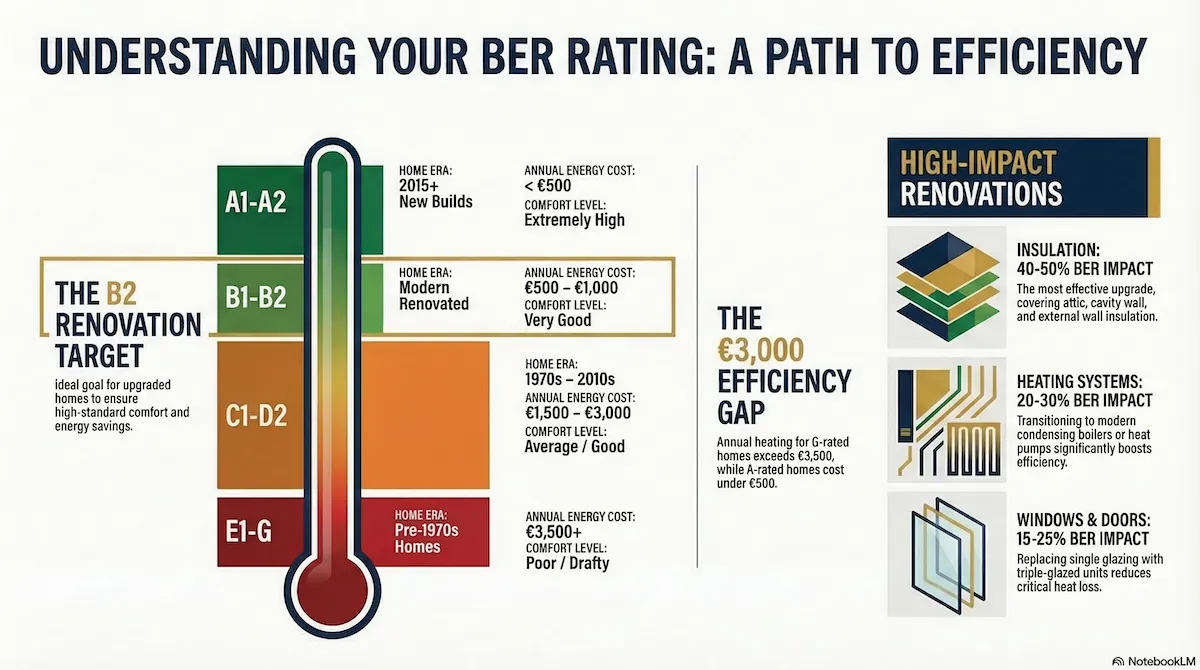
Your home's energy performance is rated on a scale from A to G, with A being the most efficient (using the least energy) and G being the least efficient (using the most energy). Here's what each rating represents:
BER Rating Scale
- A1 & A2: Extremely high energy performance. Modern new builds with excellent insulation, heat pump heating, and renewable energy sources.
- B1 & B2: Very good energy performance. High-standard renovated homes with quality insulation, efficient heating, and modern windows.
- C1 & C2: Good energy performance. Well-maintained homes with adequate insulation and reasonably efficient systems.
- D1 & D2: Average energy performance. Homes with basic insulation and conventional heating systems.
- E1 & E2: Below-average energy performance. Older properties with limited insulation and older heating systems.
- F: Poor energy performance. Significantly under-insulated properties requiring substantial work.
- G: Very poor energy performance. Severely under-insulated properties with no modern efficiency measures.
Why Your BER Rating Matters
Legal Requirement for Sale and Rental
Since 2008, it's legally required to obtain a BER certificate before selling or renting any residential property in Ireland. Your BER must be publicly displayed in property advertisements and at viewings. Properties with poor ratings (F or G) can significantly impact buyer interest and rental demand.
Impact on Property Value
A study across European markets shows that homes with better energy ratings command higher resale values and attract more buyers. In Dublin's competitive market, a property with a B-rated BER typically sells for 3-7% more than an equivalent G-rated property. Newer first-time buyers increasingly prioritize energy efficiency and lower running costs.
Direct Impact on Your Energy Bills
The difference between a D-rated and A-rated home can mean €1,500-€3,000+ annually in heating and cooling costs. A home rated G might cost €3,500+ per year to heat, while an A-rated home might cost under €500. Over a five-year period, that's a potential saving of €10,000-€15,000 through energy efficiency alone.
Comfort and Health
Better-insulated homes with efficient heating systems maintain consistent temperatures, reduce drafts, and minimize condensation and mold growth. Improved indoor air quality and thermal comfort directly benefit your family's health and wellbeing.
Typical BER Ratings of Irish Homes by Era
Your home's age is the strongest predictor of its BER rating. Here's what we typically see in Dublin properties:
| Property Era | Typical BER Rating | Key Characteristics |
|---|---|---|
| Pre-1970s (Victorian, Edwardian) | E, F, G | Poor insulation, single glazing, solid walls, old heating systems. Often requires major renovation work. |
| 1970s-1990s (Semi-detached, terraced) | D, E | Limited cavity wall insulation, older windows, dated heating. Common targets for renovation. |
| 2000s-2010s (Modern builds) | C, D | Cavity insulation, double glazing, reasonable heating systems. Often requires upgrades for better efficiency. |
| 2015+ (New builds) | A, B | High-performance insulation, triple glazing, heat recovery systems, renewable energy integration standard. |
Which Renovations Improve BER Most?
Not all renovations deliver equal BER improvements. Strategic work on the right elements returns the best energy performance gains. Here's what the data shows:
1. Insulation - The Biggest Impact (40-50% of improvement)
Wall and roof insulation is the single most impactful renovation. Heat escapes primarily through poorly insulated walls and roofs. Adding cavity wall insulation, external wall insulation, or roof insulation typically improves your BER rating by 1-2 full points (e.g., E to C). The process involves:
- Cavity wall insulation: Blown insulation into the cavity between brick layers (€1,500-€3,500 for typical semi-detached)
- Attic insulation: Adding mineral wool or cellulose to 300mm depth (€800-€1,500)
- External wall insulation: Applied to outer walls with protective weatherproofing (€8,000-€15,000+ but very effective)
- Floor insulation: Underfloor insulation or suspended floor treatment (€2,000-€5,000)
2. Windows and Doors - Major Impact (15-25% of improvement)
Replacing single-glazed or old double-glazed windows with modern triple-glazed or high-performance double-glazed units significantly reduces heat loss. Frame materials matter too; aluminum frames conduct heat, while uPVC or composite frames are better insulators. Impact:
- Full window replacement with modern units: Typically improves rating by 0.5-1 BER point
- Secondary glazing: Less effective but more affordable alternative
- Door upgrades: Seal air leaks and improve thermal performance
- Cost: €4,000-€12,000 for typical 3-4 bed semi-detached
3. Heating System Upgrade (20-30% of improvement)
An inefficient boiler or heating system drains energy and increases costs. Modern condensing boilers, heat pumps, or biomass systems dramatically improve BER:
- Modern condensing boiler replacement: €2,000-€4,000; improves by ~0.3-0.5 points
- Air source heat pump: €6,000-€12,000; major efficiency gains, especially combined with insulation
- Ground source heat pump: €15,000-€25,000; highest efficiency but significant installation cost
- Solar thermal panels: €2,500-€5,000; reduces water heating energy demand
4. Hot Water and Heating Controls (5-10% of improvement)
Thermostatic radiator valves (TRVs), programmable thermostats, and properly insulated hot water cylinders provide modest improvements with relatively low cost (€500-€2,000).
5. Ventilation and Air-Tightness (5-10% of improvement)
Modern homes require mechanical ventilation with heat recovery (MVHR) systems to maintain good indoor air quality while retaining heat. Sealing air leaks around windows, doors, and service penetrations also helps (€1,000-€3,000).
BER Improvement Impact by Renovation Type
This table shows realistic BER improvements from common renovations (assuming starting point of D-rated semi-detached Dublin home):
| Renovation Type | Typical Cost | BER Improvement | New Expected Rating |
|---|---|---|---|
| Cavity wall insulation alone | €2,500 | +0.5-1 point | D to C/B range |
| Attic insulation alone | €1,000 | +0.3-0.5 point | D to C range |
| Window replacement (all) | €8,000 | +0.5-1 point | D to C/B range |
| Modern boiler replacement | €3,500 | +0.3-0.5 point | D to C range |
| Insulation + Windows + Boiler | €13,500 | +1.5-2.5 points | D to B1/B2 |
| Major renovation (insulation, windows, heat pump, solar) | €25,000+ | +2-3 points | D to A/B range |
How Extensions Affect Your BER Rating
If you're planning an extension, understand how it impacts your overall BER. A new extension is built to modern Building Regulation standards with good insulation. However, it affects your BER calculation because:
- The new floor area increases the home's total energy demand
- The extension itself performs to modern standards (typically C/B-rated efficiency)
- If your existing home is poorly insulated (D or E rated), the new extension may lower your overall BER slightly due to increased heated volume
- However, if the extension includes an efficient heating extension and you upgrade the main house heating simultaneously, overall efficiency improves significantly
The key: Always consider upgrading the main heating system and improving the existing home's envelope alongside any major extension work to maintain or improve your overall BER rating.
Getting a BER Assessment
Who Conducts BER Assessments?
A BER assessor is a qualified professional registered with seai.ie/grants/home-energy-grants/">SEAI (Sustainable Energy Authority Ireland). They inspect your property, measure key elements, and use specialized software to calculate your rating. The assessment takes 1-2 hours for a typical home.
What's Involved in a BER Survey?
The assessor examines:
- Building structure and construction year
- Wall type and insulation levels
- Roof and floor insulation
- Window and door type and condition
- Heating system type and fuel used
- Hot water system and controls
- Ventilation and air-tightness
Cost of a BER Certificate
A typical BER assessment costs €150-€300 depending on your property size and location. This is a one-time investment that provides:
- Your official BER rating (required for sale/rent)
- Detailed recommendations for cost-effective improvements
- Energy usage estimate in kWh per year
- Estimated annual energy costs
- Personalized advice on which renovations deliver best value
Improving Your BER: A Strategic Approach
Rather than tackling improvements randomly, a strategic approach maximizes value. Here's our recommended process:
Step 1: Get Your BER Assessment
This provides baseline data and the assessor's recommendations. It costs €150-€300 and is essential before planning any renovations.
Step 2: Prioritize by Cost-Benefit
Focus first on improvements that deliver the highest BER improvement per euro spent. Typically, that means insulation and window work before expensive heating system changes.
Step 3: Bundle Work for Efficiency
Doing multiple upgrades simultaneously reduces overall cost. For example, if you're replacing windows, do the wall insulation at the same time. If upgrading heating, also seal air leaks and add loft insulation.
Step 4: Access Grant Support
The Irish government offers home energy grants (formerly the Warmer Homes scheme) to help fund energy-efficient renovations. Eligible improvements can receive 50-80% grant support depending on your circumstances.
Step 5: Get a Post-Renovation BER
After completing major work, obtain a new BER assessment (€150-€300) to verify improvements and support future property sales or rental at a higher market rate.
Authority Resources and Support
For more information on energy grants and renovation options, consult these trusted Irish resources:
- SEAI Home Energy Grants - Government funding for insulation, heating upgrades, and renewable energy installations
- Citizens Information - Planning Permission and Building Regulations - Essential guidance before starting any renovation project
Why Work with BR Building Services for Your Renovation
With 35+ years of building and renovation experience across Dublin 16 and Ballinteer, BR Building Services understands exactly how to deliver energy-efficient renovations that improve your BER and add real value to your home. We:
- Work with registered BER assessors to ensure improvements are optimized for rating improvements
- Use high-performance insulation materials and modern heating systems
- Ensure all work meets Building Regulations and qualifies for energy grants
- Provide transparent quotes and project management from planning through completion
- Help you navigate grant applications to reduce your out-of-pocket costs
- Deliver renovations on time and within budget with quality that adds lasting value
Whether you're planning cavity wall insulation, a window replacement, heating system upgrade, or a comprehensive energy-efficient renovation, our team has the expertise to maximize your BER improvement and help you create a more comfortable, cost-efficient home.
Next Steps: Plan Your Energy-Efficient Renovation
Every Dublin home has energy efficiency potential. The question isn't whether to improve your BER—it's how to do it strategically and cost-effectively. Start with a BER assessment to identify your baseline and get professional recommendations tailored to your property.
BR Building Services specializes in energy-efficient house renovations that improve BER ratings, reduce energy bills, and increase property value. Our team will help you plan, budget, and execute improvements that deliver real results.