Why You Should Upgrade Insulation Before (or During) Your Renovation
If you're planning a renovation, you're facing the perfect opportunity to address one of the most impactful improvements you can make: insulation renovation Dublin. Too many homeowners miss this window, leaving their properties under-insulated and their energy bills unnecessarily high. With over 35 years of building experience in Ballinteer and South Dublin, BR Building Services has seen firsthand how insulation upgrades during renovation dramatically improve comfort, reduce running costs, and future-proof homes against rising energy prices.
This comprehensive guide explains why now is the time, what options exist, how Building Regulations Part L affects you, and how to avoid costly mistakes.
Why Renovations Are the Perfect Time to Upgrade Insulation
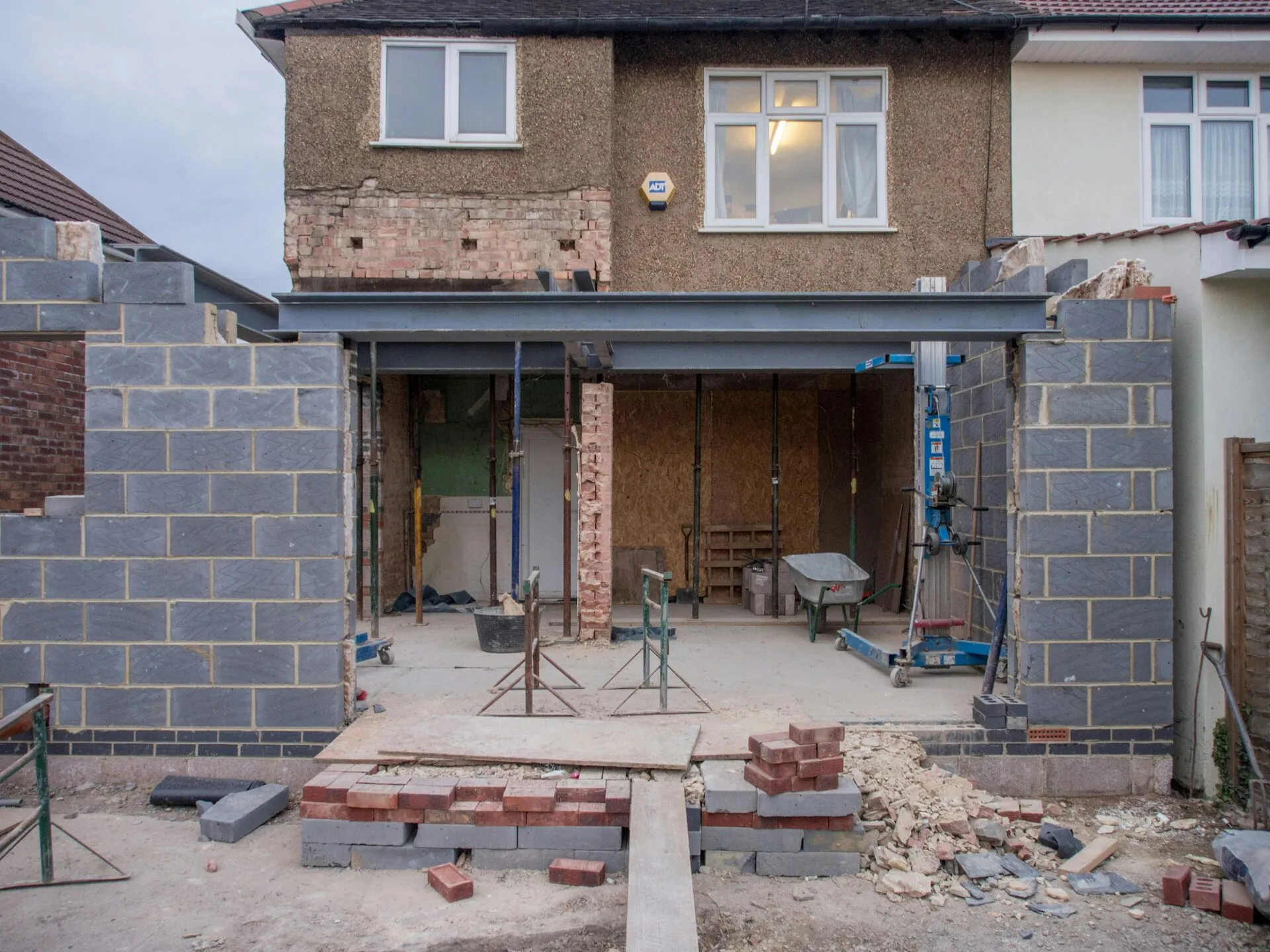
Here's the simple truth: renovations expose wall cavities, expose roof structures, and open access to floor voids. Once those walls are closed back up, upgrading insulation becomes exponentially more expensive. Retrofit work on existing properties costs 2-3 times more than installation during renovation.
When walls are open, your builder can:
- Install cavity wall insulation without the cost of drilling and injecting
- Install external wall insulation at the same time as re-rendering or cladding
- Upgrade attic insulation while the roof is already being worked on
- Install vapour control layers and airtightness measures systematically
- Fix thermal bridging issues before walls are sealed
Miss this opportunity, and you're back to external retrofit work, disruption to your home, and significantly higher costs. The insulation conversation must be part of your renovation planning from day one.
Understanding Building Regulations Part L (Energy Performance)
Irish Building Regulations Part L sets minimum insulation standards for renovated buildings. These standards are stricter than they were 5-10 years ago, and they're getting tighter. Understanding your obligations matters.
For renovated areas, Part L requires:
- Walls: U-value of 0.21-0.27 W/m²K (depending on construction type)
- Roofs/Attics: U-value of 0.11-0.15 W/m²K
- Floors: U-value of 0.15-0.20 W/m²K
- Windows/Doors: U-value of 1.4 W/m²K (double glazing minimum)
- Airtightness: Measured at 50 Pa, maximum 7 m³/(h·m²)
What This Means for Your Renovation
If you're renovating a Dublin home built in the 1970s-1990s, it likely has minimal or no insulation. To meet Part L, you'll need to upgrade significantly. The good news: this investment is mandatory, so budget for it now rather than facing non-compliance later.
Types of Insulation for Dublin Homes
Cavity Wall Insulation
Most Dublin semi-detached and detached homes built between 1970-2000 have cavity walls (two layers of brick/block with a 50-100mm gap between). During renovation, while walls are open, this cavity is the ideal place for insulation.
Materials: Mineral wool batts, rigid PIR boards, or polystyrene beads injected into the cavity.
Typical cost: €25-€45 per m² when done during renovation (retrofit injection: €100-€150/m²).
Achieved U-value: 0.21-0.27 W/m²K.
External Wall Insulation (EWI)
If you're re-rendering or cladding your home during renovation, external wall insulation is highly efficient. Rigid foam boards (PIR or EPS) are fixed to the external wall face, then rendered or cladded over.
Advantages: Excellent thermal performance, no loss of internal floor space, addresses thermal bridging at windows and corners, improves weather protection.
Disadvantages: Changes external appearance, higher upfront cost, can affect eaves/overhangs.
Typical cost: €80-€150 per m² fitted.
Achieved U-value: 0.15-0.20 W/m²K.
Internal Dry-Lining
If external insulation isn't feasible (conservation areas, cost constraints), internal insulated plasterboard (dry-lining) can be applied to wall interiors. This reduces internal floor space slightly but is faster and cheaper than external work.
Typical cost: €40-€70 per m² fitted.
Achieved U-value: 0.20-0.27 W/m²K.
Consideration: Risks condensation if airtightness isn't properly managed. Vapour control layers essential.
Attic/Roof Insulation
Heat rises, so roof insulation is crucial. Most pre-2000 Dublin homes have minimal attic insulation (25-100mm). Upgrading to 200-300mm during renovation yields dramatic improvements.
Materials: Mineral wool batts, rigid PIR boards, blown-in cellulose, or spray foam.
Typical cost: €15-€35 per m² (depending on material and access).
Achieved U-value: 0.11-0.15 W/m²K.
Ground Floor Insulation
Often overlooked. If your renovation includes removing ground floor finishes, adding rigid foam or mineral wool insulation below the floor reduces heat loss and improves comfort.
Typical cost: €20-€40 per m².
Achieved U-value: 0.15-0.20 W/m²K.
Insulation Materials Compared
| Material | Type | Cost/m² | Thermal Performance (λ) | Moisture Resistance | Best For |
|---|---|---|---|---|---|
| Mineral Wool (Rock Wool) | Batts/Rolls | €5-€12 | 0.032-0.035 W/mK | Excellent | Cavities, attics (budget option) |
| Glass Fibre Batts | Batts/Rolls | €4-€8 | 0.032-0.040 W/mK | Good | Attics, cold areas |
| PIR Rigid Boards | Rigid foam | €15-€35 | 0.022-0.026 W/mK | Excellent | Cavities, external walls, premium performance |
| EPS (Polystyrene) | Rigid foam | €8-€15 | 0.030-0.040 W/mK | Fair (moisture sensitive) | External walls (cost-conscious), cavities |
| Phenolic Foam | Rigid foam | €25-€45 | 0.018-0.022 W/mK | Excellent | Premium applications, limited space |
| Spray Foam Polyurethane | Spray applied | €35-€60 | 0.024-0.028 W/mK | Excellent | Awkward cavities, air sealing, new builds |
Common Insulation Mistakes to Avoid
1. Insufficient Thickness
Adding 50mm of insulation when 100mm is needed to meet Building Regulations wastes money and labour. You'll fall short of required U-values and need costly remedial work later. Specify the thickness needed to hit your target U-value, not the minimum budget allows.
2. Ignoring Airtightness
Insulation only works when paired with airtightness. Air leaks around windows, doors, and building junctions bypass insulation entirely. During renovation, specify airtight barriers, tape seams, and seal penetrations. Test airtightness after completion (blower door test).
3. Thermal Bridging at Junctions
Steel lintels, timber studs, and concrete floor slabs conduct heat through insulation. These thermal bridges create cold spots and reduce effective insulation value. Plan to break them with insulated reveals, continuous external insulation, or careful material selection.
4. Moisture and Condensation Risk
Adding insulation without proper vapour control can trap moisture inside walls, causing damp and decay. Always specify vapour control layers on the warm side of insulation. Ensure ventilation is adequate. In Dublin's damp climate, this is critical.
5. Not Accounting for Reduced Floor Area
Internal insulation (dry-lining) reduces floor space by 50-150mm. In a small Dublin terraced home, this matters. External insulation is better if space is tight—but it's costlier and impacts external appearance.
6. Mixing Insulation Types Without Planning
Combining cavity insulation, external insulation, and internal insulation without coordination creates weak points and moisture issues. Plan your complete insulation strategy holistically during renovation design.
Energy Savings and Payback
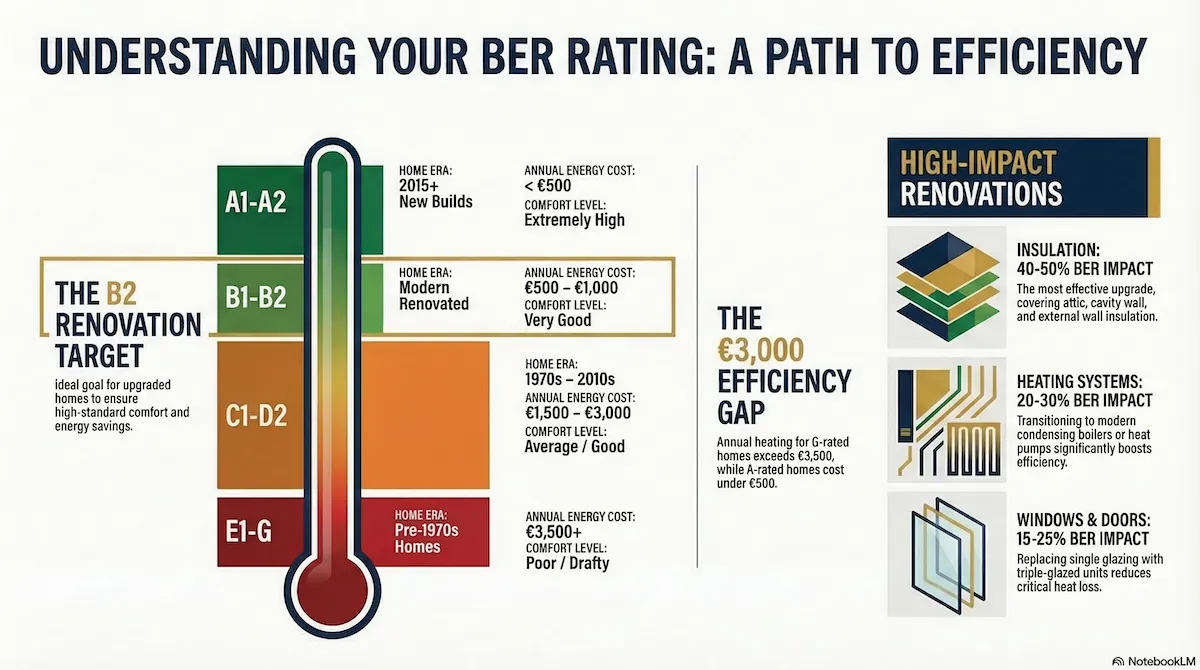
A typical pre-1990 Dublin semi-detached home with poor insulation spends €1,800-€2,500 annually on heating and hot water. Comprehensive insulation upgrade (walls, roof, floor, windows) can reduce this to €900-€1,300—a saving of €700-€1,200 per year.
For a €15,000 insulation investment, payback is 12-20 years. But you also gain:
- Improved comfort (no more cold rooms in winter)
- Higher property value (better BER ratings, compliance with Building Regulations)
- Reduced carbon footprint
- Future-proofing as energy prices rise
SEAI Grants and Funding
The Sustainable Energy Authority of Ireland (SEAI) offers grants for home energy upgrades, including insulation. The Home Energy Grants scheme covers substantial portions of insulation costs for eligible homeowners.
Grant details (2026):
- Wall insulation: Up to €8,000 grant (€0-€30,000 works)
- Attic insulation: Up to €3,200 grant
- Floor insulation: Up to €1,600 grant
- Heat pump installation: Up to €5,400 grant
Grants are subject to a BER assessment and energy audit. Combine insulation upgrade with an efficient heating system (heat pump, condensing boiler) for maximum grants and savings.
Planning Tip
Apply for SEAI grants early in your renovation planning. Approval timelines can be 4-8 weeks. Some grants require pre-approval before work begins, so don't start insulation work before grant confirmation.
The Role of Airtightness and Ventilation
Insulation without airtightness is like a sweater with holes. Even excellent insulation can't prevent heat loss if air leaks freely through cracks and gaps.
During renovation, specify:
- Airtight membranes on the warm side of insulation
- Sealed window and door frames (airtight reveals)
- Taped seams on membranes and boards
- Sealed penetrations (pipes, cables, conduits)
- Airtight junction details at wall-to-roof, wall-to-floor
After completion, commission a blower door test (€500-€800) to verify airtightness. Part L now requires airtightness testing on renovations—budget for it.
Airtightness works hand-in-hand with controlled ventilation (extract fans in bathrooms/kitchens, MVHR systems in well-insulated homes). Without controlled ventilation, airtight homes can develop moisture problems.
Thermal Bridging Explained Simply
Thermal bridges are pathways where heat escapes faster than through insulation. Common examples in Dublin homes:
- Steel lintels: Above windows and doors—steel conducts heat 100 times faster than brick
- Timber studs: In timber-framed walls—wood conducts 10x faster than fibreglass
- Concrete floors: Running through external walls
- Corner junctions: Where walls meet, concentration of heat loss
- Window frames: Aluminum frames especially—metal conducts heat rapidly
To minimize thermal bridging during renovation:
- Extend insulation continuously (avoid gaps)
- Use insulated lintels, or thermally broken metal frames
- Install external insulation wrapping corners
- Choose high-performance window frames (PVC, timber, or thermally broken aluminum)
Space Implications: Internal vs. External Insulation
Internal insulation (dry-lining): Reduces floor space by ~100mm. In a Dublin terraced home with narrow rooms, this feels noticeable.
External insulation: Preserves internal floor space but increases external wall thickness by 100-150mm. Window reveals reduce, exterior appearance changes.
For Dublin properties, especially in conservation areas, external changes may need planning permission. Discuss with your Local Authority before committing to design.
Why BR Building Services Gets Insulation Right
Insulation work during renovation requires coordinated planning, correct material selection, and meticulous detail. We've been doing this in South Dublin for 35+ years:
- We understand Dublin's damp climate and design moisture protection accordingly
- We know Part L Building Regulations requirements intimately
- We coordinate insulation with structural work, mechanical services, and finishes
- We specify U-values and airtightness targets upfront—no surprises
- We commission testing (airtightness, thermal imaging) to verify performance
- We guide clients through SEAI grant applications to maximize funding
Our insulation-upgraded renovations consistently deliver energy-efficient, comfortable, compliant homes—and happy clients saving money every month.
Getting Started
The first step is a detailed energy audit and BER assessment. This identifies where heat is being lost, what insulation measures deliver the best return, and what grants you qualify for. From there, your builder integrates insulation into the renovation plan, specifying materials, thicknesses, and details to meet Building Regulations and your comfort goals.
Don't leave insulation as an afterthought. Make it central to your renovation planning, and you'll enjoy decades of comfort, savings, and compliance.